Ann Linnea
  • Home
  • Bio
  • Books
  • Blog
  • Resources
  • Contact
  • Click to open the search input field Click to open the search input field Search
  • Menu Menu

Many Ways to Remember

September 28, 2026/34 Comments/by Ann Linnea

It has been nearly 13 years since our son Brian died as a result of a line of duty accident in his role as a paramedic captain. Over the years I have made some peace with his death. I can truly say he did more in his 33 years to live the passion of his profession than most people do in a lifetime.  And still, the ache of a mother always resides just below the surface.

Our son Brian

I, and other family and friends, remember Brian in a wide assortment of ways. This fall has held a surprising convergence of memories, ceremonies, and acknowledgments of the fine work our beloved son did for Denver Health paramedics.

Every Day

A few weeks after Brian died, I took his captain emblem into our local jeweler, told him Brian’s story and asked if he could create a pocket token for me to carry. And every day since the jeweler created it, I have carried that talisman, talking to Brian as I slip it into a secure pocket. Every day is an easy commitment. Being a mom is, after all, a forever assignment.

The pocket talisman made from Brian’s captain bars that I always carry in my pocket.

A Tattoo

My extended family held a reunion in Colorado this June. (see my June blog: https://annlinnea.com/summer-family-reunion-circle/). We miss Brian in these settings, he ALWAYS attended family gatherings.  So, it came as no surprise to daughter Sally, Christina, and me, sitting around an outdoor fire ring at YMCA Camp of the Rockies, to have a raven swoop low over us sounding its ethereal croak. Ever since his November 2013 death, each of us has had uncanny experiences of a raven showing up to signal spiritual presence.

We teared up and acknowledged this “Brian moment.” Then Sally turned to me and asked, “Would you ever consider getting a raven tattoo with me?”

Sally and Ann with their new tattoos

Pausing for quite some time, I said, “Well I did not think I would ever be drawn to have a tattoo, but this is a spiritual question and, yes, I would do this with you.” What journeys our kids take us on! They work to hold the values of our generation and invite us into the values of theirs.

We set about finding the right LA tattoo parlor near Sally’s home and a raven image that worked for us. During my recent visit, we handed our tattoo artists the watercolor drawing our friend Kelly Anderson had given me several years ago.

My annual solo camping trip

I have taken an annual solo camping trip every year since Brian’s death to scatter ashes and to spend time journal writing and in ceremony. This year the journey was also a celebration of my recovery from hip surgery in December 2025.

Ann’s Deer Park Campground site

Deer Park campground in the Olympic National Park (5,400 feet) is located up an 8.5 mile narrow, steep dirt road. It is a first-come-first-served campground with only 14 remote sites. Feeling lucky, I set up camp and took a short hike above the campground to Blue Mountain (6,000 feet). On one side of the ridge the Strait of Juan de Fuca stretched out below me across to Vancouver Island and out to the Pacific Ocean. On the other side of the ridge the Olympic mountains spread out at eye level before me.

Framed by subalpine fir at treeline, looking 6,000 feet below to the Strait of Juan de Fuca and Vancouver Island beyond.

From Blue Mountain looking towards the spectacular ridges of the Olympic Mountains


On the second day, fog swirled all around camp, limiting visibility to sometimes no more than 100 feet.  There would be no hiking off trail on this day, no getting lost. Setting off on the Deer Ridge Trail with my pack and safety gear, I left a message under a rock on the picnic table at my site.

Note left on my campground site picnic table.

I was hoping to find an old growth Douglas fir tree just below treeline—an elder to guard Brian’s ashes. After about an hour, I found exactly the tree I was hoping for and set up a simple altar for my ceremony.

By first light, day three, the temperature was 42 degrees F.(5.5 degrees C.), the wind was blowing, and the rain was coming across the valley. I had worked hard to plan and prepare for this trip. But autumn is a changeable month in the high country, and I heard the voice of my paramedic son urging me to take care of myself.  I had pushed my edges and remained safe. Brian’s ashes were scattered in yet another wild place. The spiritual aspects of camping had been accomplished, so I took down my camp and came home.

Brian Schimpf Memorial Scholarship

After Brian’s death, friends and family established the Brian Schimpf Memorial Scholarship to assist paramedic students enrolling in the Denver Health Paramedic School where Brian taught part-time in addition to his paramedic duties. Knowing the challenges to get traditional financial aid, we established this scholarship to help those with the greatest financial burden.

Since the beginning of this program, we have supported 35 students totaling $89,000. The Brian Schimpf Memorial Scholarship is now a single $3,000 award paid directly to the school account of the winning students who must submit a 500-word essay and their current W-2 forms for consideration. Awards are given three times/year for each of the 6-month, the 9-month, and the year-long training programs. Brian’s father and I, a paramedic friend, and one of Brian’s lifelong friends read the applications and decide the award.

The scholarship application letter is sent to students who have been accepted into the paramedic school: “Brian Schimpf was a respected and proud paramedic for the Denver Health Paramedic division. He embodied the true spirit and passion of a paramedic in both his skill for providing the best care to his patients and in his dedication to training the future generations of EMS workers. Brian was gravely injured while responding to a call in Grand County in 2012 and after a valiant battle and multiple surgeries passed away from complications following a surgery in 2013. After his passing, family and friends came together hoping to honor and keep his spirit and passion for EMS alive through a scholarship to help paramedic students at the beginning of their journey.”

This year the Denver Health Foundation which houses the scholarship approached us and acknowledged the success of the program. “We even have students inquiring about the scholarship before the announcement about its availability goes out to accepted students,” they wrote. They asked if we would be a part of endowing the scholarship in perpetuity. We are in dialogue with them to see if this can happen and insure that the scholarship continues beyond both his aging mother and father’s ability to carry it on.

November 23

Every year on the anniversary of Brian’s death, Christina and I spend the day in nature to write in our journals, scatter more of Brian’s ashes and share reflections, and of course, to have a good meal out. Brian loved his food!

Ann blowing an eagle whistle during her annual Nov. 23 ceremony for scattering Brian’s ashes

Losses are part of life. And these losses impact us in many ways. Dear-Readers-Who-Also-Have-Lost-a-Beloved, what rituals, ceremonies, or honoring do you keep? We are each on powerful and personal journeys, yet, not alone in our grief. I would love to hear some reflections from you.

https://annlinnea.com/wp-content/uploads/2026/09/fog.jpeg 480 640 Ann Linnea https://annlinnea.com/wp-content/uploads/2023/04/header-final.png Ann Linnea2026-09-28 00:00:132026-09-28 00:00:13Many Ways to Remember

You Don’t Bully Your Neighbors. You Just Don’t!

August 28, 2026/36 Comments/by Ann Linnea

We spent the weekend visiting long-time friends on Gabiola Island, British Columbia. It was the weekend that Canadian Prime Minister Mark Carney instructed his negotiators to walk away from tariff negotiations with the Trump administration as the US kept adding restrictions and amendments that eroded Canadian sovereignty.

Gabriola Island, BC ferry

Conversations were happening everywhere around us. “Outrageous. Mean-Spirited. Bully. Tragic. Preposterous. WHY???” These were just some of the comments we heard from people walking their dogs, sitting in the coffee shop next to us, or riding on the ferry at a nearby table.

I have lived close to the Canadian border most of my adult life. I treasure the kindness of Canadians and the extraordinary beauty of their massive country. We have many, many good friends in Canada. Being among them during this horrible historic moment helped me feel the outrage they are feeling from the Trump’s administrations most recent flagrant violation of good neighborliness and international agreement.

Ann and our friend Ingrid walking one of the Gabriola Island beaches

This is a stupid move. Our two countries have the longest demilitarized border in the world—5,000 miles or 8,000 kilometers. We share defense strategies, economic resources, recreational opportunities, family ties, and manufacturing exchanges. The tariffs are a move done by a bully to get his way and it is not going to work. The only way to work with a bully is to stand your ground and that is precisely what Prime Minister Carney has just done.

The fallout from this punitive action by the Trump administration and their inept understanding of world relations is going to be difficult for ordinary citizens in both countries. Being with my Canadian neighbors this past weekend has made me furious. This political maneuver attacks all my values about what is right action in the world. We spent much of the weekend agreeing with every criticism leveled against Trump—doing our best to be diplomats. Perhaps it helped some. Perhaps it reassured ordinary Canadians that ordinary Americans are not their government.

The United States has fallen from any semblance of world stature as a leading nation. It will not recover in my remaining years. All I know to do is to tend closely my and our Canadian friendships. To keep speaking up so my fellow American citizens don’t just shrug their shoulders as if this is all inevitable and hopeless. We are culpable if we are silent.

In an address to Canadians the day after he pulled all negotiators, Carney said: “Last spring, I warned that America is trying to break us so that they can own us. And I promised: ‘That will never, ever happen.’ We are keeping that promise.” “Canada is becoming stronger and less dependent on America. We are already giving ourselves more than they can take away. And we are just getting started.”

https://annlinnea.com/wp-content/uploads/2026/08/IMG_5446-rotated-e1787885903619.jpeg 738 668 Ann Linnea https://annlinnea.com/wp-content/uploads/2023/04/header-final.png Ann Linnea2026-08-28 02:59:352026-08-28 02:59:35You Don’t Bully Your Neighbors. You Just Don’t!

Summer Family Reunion Circle

June 25, 2026/29 Comments/by Ann Linnea

Forty of us, ages two to 80, met at YMCA Camp of the Rockies near Estes Park, CO in mid-June. Elevation 8,750 feet. Scenery backdrop: a near 360-degree view of the Rocky Mountains. For three days we enjoyed all that Snow Mountain Ranch had to offer—whitewater rafting, aerial ropes course, horseback riding, hiking, miniature golf and lots more.

Group photo by Kyle Anderson

Grandson Jaden on aerial ropes course, photo by Ann


River rafting by Erica Geib

On our third night my three sisters and I and our children and grandchildren and all spouses gathered in a circle inside around an artificial campfire. (Red flag warnings precluded a real fire.) After days of activities, the group was bonded and happily reacquainted. (The last time we had gathered was 2021 to honor our mother/ grandmother, Astrid, with a Covid-delayed memorial). To create the center for our circle, everyone lined up by age and then oldest to youngest placed one shoe in the middle in a spiral emphasizing that we are all following in one another’s footsteps.

The center of our family reunion, shoes placed oldest to youngest, photo by Lorenzo

2026 is the year of the 100th anniversary of my parents’ birth. The focus of the circle was to collect stories about “Astie” and/or “Bumpa” that we recorded for family lineage. People knew about the story gathering  ahead of time. Some had carefully thought out their contributions; others were spontaneous. And some, especially the youngers who never met their great-grandparents (who died in 2013 and 2020 ) were listeners.

Reunion stickers created by my sister Margaret. Colorado visits began about this era for us Minnesota girls to be able to see our grandparents and cousins.

4 Brown sisters at the family reunion, photo by Kyle Anderson


My family is accustomed to using circle to gather and share stories. So, only a brief amount of structure needed to be spoken: Be brief; the person with the little earth ball speaks; the rest of us listen. Some stories were funny—our dad, Bumpa, was a larger than life character with a very strong personality. Our mother, Astie, knew how to get things done with the softest of approaches.

I shared the story of helping my civil engineer father dig out dahlia bulbs from our yard every fall so they would not freeze in the bitter Minnesota winters. And then he and I replanted the bulbs in late spring. To this day I grow dahlias in my garden in honor of Bumpa who showed his creative side in his beautiful gardens—he gave his plants what they needed then expected them to behave, just as he did his entire engineering staff at George Hormel & Co., and his four daughters.

My first bush of dahlias was blooming when we returned from Colorado

The story I shared about Astie was how she used her incredible piano playing ability to build community. After Dad died, when Mom was 87, she left her hometown and moved into an assisted living near our sister Kathy a hundred miles north. As soon as Mom sat down to play piano in the lobby by the dining hall, people lingered and requested songs so they could sing along. She quickly made friends.

As the little earth ball went around the circle, there were many stories about fishing with “Bumpa” at the “Ranch”—a Colorado guest ranch our family visited every summer for 50 years. The tradition of gathering in Colorado is deeply imprinted in my family.

Stories shared about “Astie” ranged from spending time hiking along Canyon Creek, loving her cooking, and sitting with her on the porch admiring the vastness of the canyon mountains and their beauty. Both my parents cherished time in nature and passed that appreciation onto each of their four daughters and we in turn have passed it to our children and grandchildren.

It took an hour for the little ball to travel around the circle of 40 descendants—just long enough for good stories, but not so long that fidgeting overcame us. We closed the circle singing “Happy Birthday” and retired for cupcakes, casual conversations, and a magnificent sunset.

Ann and Christina outside after the family circle, photo by John Harrington

Our whole four-day gathering was wonderful, heartfelt fun. We did not talk about religion or politics. Instead, we focused on what we all have in common—love for each other, love of our families, and love for the beauty of the natural world.

As my niece, Kyle, said in the circle, “Values are not taught, they are caught.” I invite all of us to find ways to connect with family members—a little email text about something you have or had in common, like maybe sports and the World Cup soccer matches; or sending a recipe you have preserved from your family to someone who likes to cook; or  sending a link to a fun puppy video. The world could really use some re-knitting—and it can only happen one stitch at a time.

I love each of my sisters: Margaret, Susie, and Kathy. Before she died, we promised Mom we would take care of each other and we plan to do just that. photo by some beloved niece or nephew


https://annlinnea.com/wp-content/uploads/2026/06/FullSizeRender.jpeg 470 640 Ann Linnea https://annlinnea.com/wp-content/uploads/2023/04/header-final.png Ann Linnea2026-06-25 23:47:392026-07-01 03:33:40Summer Family Reunion Circle

A Spring of Tending the Young

June 8, 2026/10 Comments/by Ann Linnea

It is late spring in the northern hemisphere. School has adjourned for summer recess.  Birds and mammals are tending their offspring. And the first of the summer bean seeds are rising out of their fertile darkness into sunshine. It’s an important time to be tending the young in our lives.

Teaching elementary children

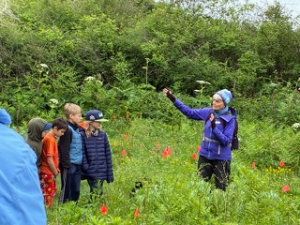
I have just finished a spring of  teaching elementary-aged youngsters attending field trips at our local Whidbey Camano Land Trust preserves. It is fun, demanding, and rewarding. The yellow school busses pull up in front of the preserve we happen to be teaching at and out pour 60-75 children, their parent chaperones, and teachers.

School busses unloading students. Rain or shine we hold these field trips. Whidbey kids are used to preparing for weather, photo by Ann

A field day! What could be better?!? About a dozen of us, volunteers and staff, meet them and lead them to learning stations varying from a plant scavenger hunt, to soil microscope work, to salmon games, to watercolor drawing, to learning about the forest or prairies. (With special appreciation to Land Trust outreach staff Andi Kopit, Ashley Hironimus, and Jen Hajny who put in incredible hours preparing and implementing these trips.)

First graders working in pairs on a scavenger hunt, photo by Jenny Son

Ann teaching fourth graders about prairies on Whidbey, photo by Maribeth Crandell


Second graders spending quiet solo times at their “sit spots”, photo by Ann


Then six hours later the kids climb back on their busses carrying home new insights and stories from their time on the land. Parents and teachers have also gained new appreciation for the incredible beauty of our island life.

A neighborhood of does with fawns

Our neighborhood has many trees and open spaces—good habitat for deer. In May and June the does give birth to their fawns in surprising places. A few years back on my birthday I watched one being born outside my office window. This year we are taking care of a neighbor’s property and a doe jumped over their backyard fence to give birth to a fawn.

A two week old fawn in our neighbor’s backyard, photo by Christina Baldwin

We have left the gate open so mama can decide when to take her baby out into the world. Another neighbor had twin fawns dropped in their backyard. We all talk with one another, keeping an eye out for the fawns.

Robins building nests

I just noticed that a robin has built a nest over the entrance to our office in the two days I did not go back there!

Robin’s next on the beam  above the window to our office, photo by Ann

Probably a safe place from crow predation, but it will mean serious cleanup work when the chicks fledge. Now that the mom is sitting on the nest, I won’t destroy it. It’s a small price to pay for the privilege of providing safe harbor for a mother robin.

Young bean seedlings

And the garden!!! Oh my, spring is a glorious time for tending the earth! I share here the picture of our bean seeds now sprouting.

Sprouting bean seeds inside a tiny protective fence for crow protection, photo by Ann

Once they emerge from the ground, they have to be carefully fenced until they are about 4 inches tall or the crows will come pull them out and have a feast. Tending, tending, tending—so many wonderful ways for me to care for the earth.

This little fence will be removed in about two weeks depending on how warm or cold it is. Right now at 50 degrees F.(10 degrees C.) they are STOPPED. Once we edge over 65 degrees F (18 degrees C.) again, they will shoot up fast.


Rachel Carson quote

“If a child is to keep alive his inborn sense of wonder, he needs the companionship of at least one adult who can share it, rediscovering with him the joy, excitement and mystery of the world.”   Rachel Carson, The Sense of Wonder (1956, Harper and Row, NY)

This is the quote that has guided my adult life. My friends and colleagues Paul Treuer, Marina Lachecki, and Joe Passineau and I published Teaching Kids to Love the Earth (1991, Pfeifer-Hamilton, Duluth, MN) detailing outdoor activities for parents and other teachers. Each of us continues that philosophy with our now grown children, nieces and nephews, and grandchildren.

Tending all this “younger” energy—human, animal, plants– is a glorious way to bring  joy into anyone’s life.

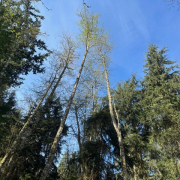
Fourth graders and Ann looking up at an old growth Douglas Fir wind sculpted tree—trees over 250 years of age standing on the coast against fierce winds, photo by Maribeth Crandell

https://annlinnea.com/wp-content/uploads/2026/06/kids-on-the-scavenger-hunt-1.jpeg 640 360 Ann Linnea https://annlinnea.com/wp-content/uploads/2023/04/header-final.png Ann Linnea2026-06-08 22:29:482026-06-08 22:29:48A Spring of Tending the Young

Passing the Baton

April 26, 2026/24 Comments/by Ann Linnea

He was 10. We were 65 and 68. We were on a 12-day spring break camping trip to honor our grandson’s double-digit birthday: 4 states, 3 national parks, one national monument, and 2 state parks.

Three adventurers on their multi-state 2015 desert spring break camping trip: Nina, Jaden, Ann

2015 campsite with Jaden, Nina, Gracie, big tent, campfire and Rav 4, Zion National Park Campground


We picked trail names for ourselves the day we walked Zion National Park’s Virgin River wearing drysuits and booties to get through some of the deeper holes in the snow melt river. He became Captain Rock. His Nina became Major Boulder. And I took on the title of Lieutenant Dipper—after the amazing little water birds we saw on this hike.

The three river walkers: Lieutenant Dipper, Captain Rock, and Major Boulder

Jaden and Ann wading the Virgin River in Zion National Park in rented drysuits, 2015


It was a remarkable trip for all three of us and included highlights like helping Jaden earn his junior ranger badge at Grand Canyon National Park, learning to put up and take down the big tent, taking hikes with our dog Gracie (who Jaden named Scout), making campfires and studying the stars.

Scout (Gracie) and Captain Rock (Jaden) looking at the view in Kodachrome Basin State Park

Jaden being sworn in as a junior ranger in Grand Canyon National Park

Nina and Jaden studying tracks on the trail

Jaden and Ann in a quiet nature identification moment at Joshua Tree National Park


Returning to Joshua Tree

The final stop on that 2015 trip was Joshua Tree National Park. Eleven years later during spring break we returned to Joshua Tree with Jaden’s entire family: Christina and I, daughter Sally, son-in-law, Joe, and Jaden now 21 and Sasha now 15.  No camping this time. Sally found an Air BnB close to the park.

Sally, Jaden, Sasha, and Joe 2026 spring break

Sally and Joe at Heart Rock, near Arch Rock

Sally and Sasha near Arch Rock


Jaden and Sasha under Arch Rock


We arrived during an unusual March heat spell with afternoon temperatures rising to 95 degrees F. (35 degrees C.). Conferring over dinner, our little family decided to hike Arch Rock Nature Trail.

Joshua Tree is a vast wilderness park in southern California where the Mojave and Colorado desert ecosystems meet. It is known for its Dr. Seuss-like Joshua Trees (Yucca brevifolia). There are warning signs everywhere about the potential for sudden and extreme changes of weather—from flash floods to snow to thunder and lightning storms to heat.

Blooming Joshua Tree with snow-capped mountains in the distance

A different outdoor adventure

We chose the Arch Rock Nature Trail from the Short Walks listing offered by the park (1.4 miles, 100 feet elevation gain), because it offered the promise of some interesting features like boulder hopping and climbing and did not seem too lengthy considering the heat forecast.

Joshua Tree National Park is a vast wilderness area known both for the Joshua trees and for its boulders

A chuckwalla lizard sunning itself on a boulder


It’s hard to get a family of young people going early in the morning. We managed to arrive at the trailhead at 10 a.m. finding one last spot in the parking lot. (Apparently most people believed park warnings about starting your hike before 9 a.m. in hot weather.) This is a section of the park that contains numerous granite rocks known for their course texture and beautiful array of shapes and sizes.  Both amateur boulder hoppers and professional boulderers  are drawn to the area. There were dozens of spring break families like ours with children of all ages walking along the relatively flat, sandy desert path through Joshua trees, creosote bushes, and prickly pear.

Once we entered the area of multi sized boulders, there were a maze of trails leading to the arch—all of which required stepping up and over or between boulders. Jaden and Sasha were off and scrambling. Sally and Joe stayed close to us and provided some much-needed “hand hoists”. Whether through observation of his father and mother’s helpfulness or his own innate kind nature, after a time Jaden started being the one to extend his strong hand to hoist his grannies up at different places along the trail.

Adventuring grannies, Ann and Christina, appreciating good help in boulder hopping

Sasha brought almond flour so she could make a gluten-free/sugar free banana cake for all of us.


A new rite of passage for the grannies

 Eleven years ago, on his rite of passage camping trip Jaden was  4’ 8 inches tall and weighed about 80 pounds. Then we were teaching him how to make a fire, to find his way and be steady on trails, and helping him up and over river boulders. Now he is 5’10 inches tall and 160 pounds strong. We needed his help as we climbed up and over and around huge abrasive boulders. We have aged (Nina is now an octogenarian) and I have had five surgeries—knee, toe, back, wrist and hip. We three still need each other, but now in different ways. Our service to Jaden away at college is primarily as witness and listening ear. His service to us on this trip was as physical guardian.

The baton of support between us has changed and morphed, as it should over time. But the baton can only be passed when there is awareness from both sides and a willingness to step into new relationship. We had to acknowledge the need for help, and he needed to recognize that help was needed.

I probably could title this blog: Passing the Baton, Part I

Christina and I will find ourselves in this kind of role reversal more and more in the years to come with our little family. Sasha actually stepped forward on this trip and shared an important nutrition video from her health class that was educational to all three of us. Sally did all the driving and played a major decision-making role in activity choices. Joe was breakfast cook and ever present as helper and organizer. May we be gracious and willing to ask for help. And may our grandchildren and children continue their growth as strong, helpful human beings.

Both Christina and I no longer have living parents. We were very much involved in receiving the batons of responsibility (along with our siblings) from our parents. Both roles— the receiver and giver of responsibility— are critical to the smooth functioning of the ongoing march of generations.

“Smooth functioning” does not seem to be happening much in the world these days. Being gracious in our own little corners of the world in both receiving and passing the baton of responsibility, IS an important piece of activism. That thought brings me comfort and hopefulness in these times.

We took this photo in our 2015 walk through Zion National Park. Geology teaches us a timeless patience and the promise of both fragility and stability.

https://annlinnea.com/wp-content/uploads/2026/04/Maga-and-nina-inthe-desert.jpeg 480 640 Ann Linnea https://annlinnea.com/wp-content/uploads/2023/04/header-final.png Ann Linnea2026-04-26 00:12:162026-04-26 00:12:16Passing the Baton

The Ritual of Returning

April 8, 2026/36 Comments/by Ann Linnea

It had been five months since I walked my little dog in our local state park. Five months and a lot of recovering—first from the broken wrist from slipping on a wet, slick plank in the park, then from right hip surgery.

The park, too, has been recovering from the storms of winter. As Vivi and I walked through the forest on a glorious sunny morning, there was much evidence of downed trees from winter winds.

An old red alder tree has fallen over an already rickety bridge

Trail crews came through recently and cleared this section of the trail


She and I returned easily to the ritual of our forest walks. We take our time. I let her sniff what she wants to sniff. She lets me take photos of what I want to photograph. It is an easy camaraderie between us.

The distinctive smell of the skunk cabbage emanates from every wetland in the forest.

Stinging nettle is beautiful and edible at this stage of its life cycle. (If you steam it as a green)


On that morning both the forest and I were in early spring time blossoming. For our Northwest forest the early bloomers are salmonberry, osoberry, and skunk cabbage. The stinging nettle is sprouting up everywhere. For this forest walker the  “early blooming” took the form of hiking without poles and wearing a backpack for the first time since embarking on my long healing journey. It felt so good. My legs and back were strong. My little Corgi dog and I were back in stride.

Pausing at a bench at the highest point of the 2.5-mile Upper Loop Trail, I turned on my Merlin Bird ID app to help my ears acclimate to forest bird song. In just two minutes I recorded: chestnut- backed chickadee, American robin, yellow-rumped warbler, golden-crowned kinglet, ruby-crowned kinglet, orange-crowned warbler, and Northwest flicker. It is April. The warblers are beginning to return from their long winter’s journeys, too!

The sound of the orange-crowned warbler is fast and high-pitched—a kind of celebratory call in my mind. Any bird returning from migration deserves to celebrate! This five-inch long, yellow-green bird has likely just flown from somewhere in the south western U.S., a journey of at least a thousand miles! Like all wood warblers, the orange-crowned warbler is difficult to spot as it flits from one shrub to the next. But it is much easier to spot now than in a month when all the shrubs will be leafed out. I sit in delight listening to its song over and over again.

Muddy trail with slick tree round stepping stones.

The journey down the back side of the Upper Loop trail at South Whidbey State Park is muddy this time of the year with tree rounds and planks placed haphazardly to help hikers keep up out of the mud. I am super careful in my foot placement. Vivi just wades right through the mud, apparently delighting in squishy mud between her toes. She is confident and my confidence is returning.

We see no one on the trail, though it is the first warm Sunday morning in a month. However, looping back through the campground to our parked car, morning walkers are beginning to arrive. Vivi loves meeting people and other dogs because if she is well behaved (and she nearly always is) she is rewarded with a little cookie. I love meeting people, too, because they are usually happy and appreciative. All of us have left behind the human world of news which includes far too much saber-rattling these days. We have come to immerse ourselves in the magnificence of spring. Gratitude is the commonly shared emotion. I am so very grateful for today’s ritual of returning to our forest walks.

View from one section of the trail looking across Puget Sound to the Olympic Mountains.

This iconic big leaf maple is the guardian to the trail out of the campground.


P.S.  Can you tell I am unusually excited about spring this year? An update from last month’s blog about the old crabapple tree.: she is now covered with blossoms ready to burst. Turns out measuring her leaf’s growth was a slow thing. I switched to measuring the growth of our peonies. A growth of 2 inches per day has not been uncommon as the sun grows stronger in its northward march of spring!

Measuring the growth of our peony shoots using my hoary-hoary weeding tool as a ruler.

Our crabapples blossoms ready to burst this year.

https://annlinnea.com/wp-content/uploads/2026/04/alder-trees-not-yet-leafed-out-1.jpeg 480 640 Ann Linnea https://annlinnea.com/wp-content/uploads/2023/04/header-final.png Ann Linnea2026-04-08 03:43:582026-04-08 03:43:58The Ritual of Returning

Attending to the Changing Season

February 9, 2026/22 Comments/by Ann Linnea

It is winter in the north country. Much of the plant and animal world is slowed down to the level of hibernation and dormancy—in survival mode. To survive our challenging political times let us remember the importance of rest and being refilled.

Ceremony invites a pause

In this early time in February the northern hemisphere is moving from the winter solstice to the spring equinox. (Our southern hemisphere friends are, of course, that much closer to the fall equinox and harvest.)

We usually have an outdoor fire to stop and take notice of this time, but this year because I am still recovering from hip surgery and get stiff in the cold, we  gathered around the indoor wood stove with candles, drums, and poems. We began by drumming gratitude for the earth which sustains us in all we do and all we need. Then we offered prayers for humans all over the globe who are suffering from oppression, hunger, and pain. As a Minnesota native, I continue to be in regular contact with family and friends living there so much of our prayer energy focused on the brave people of Minnesota for their courageous resistance to the brutal attacks by ICE agents on their community.

A fire, a candle, a drum—all ingredients for an earth celebration.

Hundreds of Minnesotans stand on a frozen lake spelling out and SOS from their state to the world (Instagram photo)


Spending time outside to feel the earth

Whether we are 8 or 80, spending actual time outdoors walking, playing, gardening, watching birds or just sitting enlivens and opens our physical bodies to the wisdom we all carry within.

  • If you are in the far north and hearty, walk on the snow or ice, sled down a nearby hill, feel the crisp cold on your cheeks. How are the wild animals you cherish surviving in these times? The plants? Do you feed the birds? How often? What species do you notice?
  • If you are in a moderate climate like my own, go to your garden or yard or a park and be amazed at how much activity there is—heather blooming, insects beginning to “wake up”, humming birds zipping around feeders. If you are a dog owner, pay attention to what they are sniffing and noticing on your walks. Have the cottontails begun to move around? How does rain or mist feel on your face?

Ann “side dressing the garlic” in February by adding blood meal to the soil near where the bulb will form.

  • If you live in a southern climate, be appreciative of a relief from hot temperatures and notice how plants are marking the movement from full blossom into harvest time. Have you seen migrating birds? What plants are beginning to bloom near the end of summer? What plants have already completed their cycle?

We are mostly human centric in the dailyness of our lives. And we don’t necessarily need to go outdoors to heighten that connection.

The arts connect us to the natural world

Artists, poets, writers, singers and photographers help bring our beleaguered hearts into open connection with the profound, healing beauty of the natural world.

  • There are many master nature writers that call us into story or information that reminds us that we are as much a part of the natural world as we are the human created world: Terry Tempest Williams, Aldo Leopold, Rachel Carson, Merlin Sheldrake, Robin Wall Kimmerer, Sy Montgomery, David George Haskell, and Suzanne Simard to name a few. I highly recommend this new book: All Creation Waits, The Advent Mystery of New Beginningsby Gayle Boss with marvelous illustrations by Sharon Spitz.

A potpourri of nature book titles from Ann’s bookshelf

  • And the poets, oh, the poets! They pull us into such deep connection with the natural world. Mary Oliver is a master nature poet of our times. Any number of her titles can open our hearts to Nature: “Invitation” from her book Red Bird; “When I am Among Trees” from her book Thirst; “Mushrooms” from American Primitive ;and “First Snow” also from American Primitive.
  • I don’t draw or doodle much, but I remember a time decades ago coming indoors about this time of the year after making a northern Minnesota snowman with my children, Brian, age 9, and Sally, age 6. We pulled off our considerable snow gear and brought out paints and crayons and attempted to move our outdoor creation indoors onto the page. My outstanding memory from that session was Brian saying, “Mom, that is a really good picture!” Not sure my artwork has been appreciated before or since but drawing with children can be very empowering!
  • Christina is our sunset photographer, even creating an annual calendar of sunsets

  • Music opens the whole body, the whole soul. When I am feeling happiest outdoors, I burst into song. In a very different approach to protesting the abuses of ICE right now, people have joined “singing resistance” choirs. They are practicing in churches and community centers and often travel to places where ICE agents are staying or working to appeal to the humanity that resides inside all of us.

Friends, these are trying times. Let us do our best to fill our souls with joy and beauty and radiate that out into a world desperately in need of both.

I close with this poem from a newly published book of poetry and photographs by my friend, Katharine Weinman—Skyborne Insight, Homemade Love. (Blog: www.awabisabilife.ca Website: www.katharineweinmann.com
Email: panache@interbaun.com) It touches my heart deeply to see how exquisitely she honors an old tree in this poem that speaks to her the truths of aging.

Where a Poem Resides

With a fleeting first glance,

I walked past you standing along the path,

instead giving more attention to my footing

and my morning conversation.

But something about your

weathered features struck me. I knew

I needed to see more of you.

So, I turned around.

Retraced my steps.

Approached you, reverently.

Raised my camera ready.

And at that moment,

the sun shone through the clouds,

and through your whole and broken branches,

giving me light enough to take you in.

To appreciate the gnarled beauty of your trunk

and your mottled bark skin, life force rallying

in your autumn leaves’ amber glory.

And at that moment,

I knew a truth of yours and mine.

That inside both of us is where a poem resides.

A poem that speaks to aging and how it takes us

to the edge. Makes us less visible, and eventually

barely there.

That despite our hard-won strength

and wizened beauty, our steadfast presence

through life’s seasons and storms, soon will come

the one that fells us. Breaks our limbs. Pulls us

from the ground of our being. Then falling

to the earth, or buried within,

we’ll become the compost for new life.

Our death our new beginning.

https://annlinnea.com/wp-content/uploads/2026/02/CB-sunset-rotated.jpeg 640 480 Ann Linnea https://annlinnea.com/wp-content/uploads/2023/04/header-final.png Ann Linnea2026-02-09 20:30:182026-02-09 20:30:18Attending to the Changing Season

Tiptoeing out of Hibernation

January 15, 2026/40 Comments/by Ann Linnea

In the early morning winter darkness, I move around inside our house with sure footedness. We have lived in this home for 30 years. I know the path down the hallway in the dark to my office to find the light switch that won’t wake my sleeping partner.

“Surefootedness” is a key phrase here. Coming out of a month of recovery from hip replacement surgery, I have left behind the walker and the cane and am now confidently moving around on two nearly strong hips.

Healing from surgery in December was a sort of hibernation—an inward time except for the visits of some friends. Certainly, it involved lots of sleep—both naps and long nights. Unlike the hibernating bear, though, I remained aware of the changes outside my home.

Into the Shock of Recent Trump Actions

Since my surgery on December 15, the U.S. has illegally invaded Venezuela capturing and removing its governmental head and taking over their oil supplies; Minnesota has literally been invaded by thousands of brutal ICE agents that are terrorizing citizens, including murdering one innocent white woman; and Trump is saber rattling against our own NATO alliance members Greenland and Denmark. Coming out of the hibernation and retreat-like setting of our home, I am in shock.

And so, in my first “public” outing since the surgery I joined our local ICE OUT protest here on the island. Using two hiking poles for stability, I was proud to be taking a stand with other protestors against the horrible things currently happening in Minnesota.

Ann and Christina protesting at local ICE OUT NOW


Out of Hibernation

I have been calling friends and family in Minnesota to share support. I have also been calling our senators and representative. Our Democratic Senator Patty Murray is the ranking Democratic member of the Senate Appropriation Committee. I have asked her to cease funding for ICE immediately. We watched Minnesota Governor Tim Walz give a powerful six-minute speech to his state on January 14 calling for calm and congratulating them on the ways they are coming together to resist peacefully, including escorting teachers and students to and from school and supplying people with food who are afraid to go out.

Current photo from Minneapolis from Instagram

Coming out of hibernation I feel fierce about joining with others in the most effective way possible to oppose the evil that is going on in my country right now under the pretense of governance. We must not isolate. That is precisely what Trump’s fascist government and his gestapo ICE thugs would have us do—retreat in fear and isolation.

We all Need an Antidote for Stress

There have been many protest times in my 76 years of life—the Viet Nam War, the first Earth Day, the Gulf War, Standing Rock—the list is long. A lifetime of activism is never done and the maintenance of energy for a lifetime of activism requires a solid core of spiritual care and wellness. Time outdoors has always been my antidote for wellness.

Ann on her porch with walker at her side during recovery

Right now in the mild climate of western Washington hellebores, heather, and sarcococca (sweet box) are blooming—a source of beauty and wonder to this native Minnesotan who scarce can still believe flowers bloom in January! Opening to nature’s beauty keeps alive a much needed sense of wonder about our natural world.

Heather blooming by our front walkway

Hellebores about to bloom in the shade of our backyard

Tiny Sarcococca (sweet box) flowers waft their fragrance out to anyone passing by


In talking to my Minnesota relatives and friends about the importance of self-care to prevent burnout I speak about exercise and connection to nature.

One of them texted back, “I was joking the other day that all the moms in Minnesota are going to be very fit because everyone I know is exercising extra to stay sane.”

These are perilous times for our entire country, not just Minnesota. However, we do have the strength to resist and turn this horrible tide. In Nazi Germany and Austria in the late 1930s Hitler was on the rise. Citizens of those countries had only known of democracy or a Republic for a couple of decades. In the United States we have known democracy for 250 years. We are a nation made tremendously strong by diversity that will not be put into a box of white nationalistic supremacy!

https://annlinnea.com/wp-content/uploads/2026/01/Minneapolis-now.jpeg 1280 783 Ann Linnea https://annlinnea.com/wp-content/uploads/2023/04/header-final.png Ann Linnea2026-01-15 22:05:352026-01-15 22:05:35Tiptoeing out of Hibernation

Let Your Light Shine

December 14, 2025/30 Comments/by Ann Linnea

Commercial light display, (photo by Ann Linnea)


Commercial lighting, (photo by Ann Linnea)


Lights add so much to this dark time of the year in the northern hemisphere.  November’s lingering foliage on birch and willow has been mostly blown off the trees by December’s storms. The prevailing colors of our landscape here are gray/green/brown. People in the Pacific Northwest talk about the arrival of The Big Dark. Our daylength is less than eight hours long. And if you count the general gloominess of the prevailing weather, it can seem like we are living in unrelenting shadow.

We seek the light. Inside are candles and twinkling light strings adorning plants and corners, decorated trees, lamps set to glowing, and fires in the hearth. Outside holiday lights outline houses, doorways, driveways, landscaping. I like to think that all this attention to small and beautiful lights inspires me and the people around me to tend to the small and beautiful gestures that light our way through winter shadows. A kind stranger opens the post office door for me, a neighbor brings over a baked treat, or one of my sisters calls.

Our mantle lights, (photo by Ann Linnea)

Our outside bush lights, (photo by Ann Linnea)


People helping people in challenging times

And this year, we not only have The Big Dark, but we are also experiencing record breaking flooding all over western Washington—The Great Flood. In the midst of natural disaster,  stories of mutual aid rise as fast as river waters: neighbors help neighbors, rescue workers risk their lives for strangers, people sandbag homes and businesses located in 100-year flood plains, farm animals arrive at the county fairgrounds, and in an amazing few hours, an animal shelter found foster homes for 120 cats and dogs. The goodness of human beings helping one another in challenging times shines incredible light into dark moments. What’s happening here—and so many places in the world is that “first responders” are ordinary folks stepping into the needs that show up. When we change our day for our community, we mend the larger picture of what’s going wrong to what’s going right.

Rescue of a family in Snohomish, WA (photo by Ken Lambert, Seattle Times)


Placing sandbags at the Sultan, WA post office (photo by Nick Wagner, Seattle Times)

A-very-shy-husky-mix-being-consoled-at-the-Everett-Animal-Center-before-being-placed-with-a-family (photo by Karen Ducey, Seattle-times).


Connect to the more than just human world

I have also been gratified to hear radio and television reports that include Nature in the scope of disaster. How the Chinook salmon eggs in all our rivers where the run just completed are being destroyed by raging currents, how trees are being swept downstream, how Puget Sound is being muddied and afloat with logs and toxic debris. Nature cannot move out of the way of its own forces. There is no shelter from its own storms.

Never underestimate the importance of appreciation. Whether you live in a snowy environment or you are in the far south, take time to step outside. What plants or animals do you see? One of the first things I hear outside this time of the year are hundreds of robins singing their happy chirpy songs as they feed on the beautiful red/orange berries of the evergreen madrone trees. Abundance of robins. Abundance of berries. There is abundance of food and life outside my window even if at superficial glance it seems dreary and even lifeless.

Ripe berries of the evergreen madrone tree that so many robins eat this time of the year, (photo by Ann Linnea)


Tend to something outdoors—a hummingbird or seed or suet feeder, even a weather station. Or make daily observations of something out your window—a given time of the day watching your bird bath for squirrel or bird activity. Appreciation and observation are important gifts to the world even, if they are not verbal.

My invitation to you if you are feeling overwhelmed and discouraged by today’s news cycles is to step outside yourself and find a way to light up the world around you—literally a candle or the extension of kindness—whether it is your partner, your pet, your neighbor, your local clerk, your healthcare worker or your wildlife. It certainly will make YOU feel better.

Our Christmas tree, just put up this very night before I head into the city for hip surgery. (photo by Ann Linnea)

https://annlinnea.com/wp-content/uploads/2025/12/candle-rotated.jpeg 640 480 Ann Linnea https://annlinnea.com/wp-content/uploads/2023/04/header-final.png Ann Linnea2025-12-14 03:47:592025-12-14 03:47:59Let Your Light Shine

Going the Distance

November 4, 2025/52 Comments/by Ann Linnea

Decisions made in our youth show up for reckoning as we enter our elder years. As I prepare for right hip replacement surgery in mid-December, I am reckoning with my life-long definition of myself as an athlete, including the wear-and-tear of training, the endurance and exhilaration of racing, the costs of being my age and being among the first women to accomplish some athletic feats before there was proper gear.

My history of running

Growing up in the 1950s and 60s, there were no girl’s high school sports teams in Minnesota. Thanks to a father who encouraged his four daughters to be physically active, I joined recreational swimming, tennis, and golf leagues throughout my school years. Title IX, legislation to eliminate sex discrimination in sports and athletics, wasn’t passed into law until 1972. I was 23 then, married, following my husband through his graduate school years, and living in Logan, Utah. That July, I overheard a sports caster announce, “Once again not a single woman entered the Deseret News Marathon.” I made up my mind to run it in 1973.

1978 bicycle race—before people were wearing helmets—came in third place behind my longtime friend Janelle Brown. I have no pbotos of running the 1973 marathon.

At the time, women’s running shoes were made using a man’s mold. (It was not until 1978 that Nike created the first women’s running shoe.) Since I have very narrow feet, the only shoe that fit me was a Penny’s tennis shoe. With no clue how to train for a 26.2-mile marathon I found other local women runners to train with.

Five women entered the Deseret News Marathon in 1973: three of  us finished. I have no idea my placement, only remember I was staggering into the downtown celebration of Pioneer Days with three miles to go, ready to step out and call it enough. Cheering penetrated my exhaustion, getting louder and louder. “Oh my gosh,” I realized, “they are cheering for me!” So, riding on their confidence, I crossed the line.

Trails, streets, short races, long races: there is a freedom to running that I always cherished and still miss. I developed hairline fractures in my feet, bone spurs, and swollen knees. But I was always thin and loved the freedom of being outdoors at the edge of my own wildness.

Crossing the finish line for the 1978 30K Temple Peak race in Logan, Utah. Wooden skis and wool knickers. I actually skied more races than I ran, Finishing my last 50K race in 1990 with modern skate skis and skinny tights.

In 2005 when our dear grandson, Jaden, was born, I decided to trade walking for running. “Got to accompany this boy for a long time,” I told myself. And in this year, when he completed a backpacking trip with a college friend in northern California, I will be getting a hip replacement. Then he and I will do more hiking.

No pain, no gain

As an athlete who never experienced formal coaching, I was often guided by the adage, “No pain, no gain.” Perhaps coaches say that, but most certainly athletes  say that to one another. That was a helpful phrase when it came to pushing to do things like finish that Deseret News Marathon. It was helpful on many days when I was exhausted paddling around Lake Superior and absolutely needed to keep going to be able to find a safe shore to land on. But as I have aged, the limitations of that phrase become more and more obvious. Pain is a legitimate warning that injury is not far behind—especially in older, less flexible, less strong bodies.

The phrase that aging athletes share is, “You’ve got to use it, or you lose it.” There is a tremendous amount of truth in that phrase. Become sedentary and you will have a hard time hiking, biking, swimming, or kayaking again. As I prepare for surgery and am dealing with a lot of pain, I find myself juggling between the athletic adage of my younger years and the adage of my elder years. Even if it hurts, get out there and hike at least a mile. Spend more time swimming because it does not hurt. Spend time every day in the garden weeding, planting bulbs, planting cover crop but not too much time. How much time is “too much?”  Well, if I only did what did not cause pain, I probably would not spend any time in the garden. Every day is different. The choice of how long to do an activity changes each day, a balancing act between going into my surgery as strong as I am able and not injuring myself.

Moving dirt into the garden in preparation for planting garlic bulbs this fall.

Christina helping in the garden as we harvest carrots.


How surgery snuck up on me

I have had several surgeries related to my extreme athleticism—feet, one knee, and lumbar spine. And now another joint needs replacement. This one has taken me by surprise because it did not hurt until last July when goofing around with my sister doing jumping jacks. It was fun at the time, but 24 hours later it was not fun. My physical therapist treated me for a strained hip flexor. When it didn’t heal, he sent me to my primary care doctor for an x-ray “in case there is some underlying arthritis”.

Well, there is— I have serious osteoarthritis and bone on bone in the joint. So, the next step has been to find a surgeon and get scheduled as soon as I can—December 15 will be the date.

In our 70s all of us experience some aging effect after decades of wandering this earth in our bodies. Genetics, body type, usage, adjustments, and good fortune, all determine our state of health as we age. Denial or acceptance of health insurance determines what we do about it.

I don’t regret my choices to be a runner, a cross-country ski marathoner, and a long-distance kayaker. These athletic endeavors shaped who I am as a person. In training and achievement, athletics have grown my soul and expanded my sense of self. I also appreciate the fact that I have played a small part in opening up opportunities for other women to participate in athletics.

And to you, dear readers of this blog, blessings on your own health journeys. Whether you are lucky enough to be at a place of no calibration of activities because of pain, whether you deal with chronic aches and pains, whether you also face some medical intervention like surgery, take good care or yourselves. Carry on being a force for good in your families and communities. The world needs our presence right now.

Ann heading to her plane gate to visit her daughter and family with the aid of a hiking pole.

https://annlinnea.com/wp-content/uploads/2025/11/Ann-moving-wheelbarrow-rotated.jpeg 480 640 Ann Linnea https://annlinnea.com/wp-content/uploads/2023/04/header-final.png Ann Linnea2025-11-04 01:36:212025-11-04 01:36:21Going the Distance
Page 1 of 41234

Recent Posts

  • Many Ways to Remember
  • You Don’t Bully Your Neighbors. You Just Don’t!
  • Summer Family Reunion Circle
  • A Spring of Tending the Young
  • Passing the Baton
  • The Ritual of Returning
  • The Old Crabapple Tree
  • Attending to the Changing Season
  • Tiptoeing out of Hibernation
  • Let Your Light Shine
All text and photographs copyright ©2026 Ann Linnea. Privacy policy >>
Scroll to top Scroll to top Scroll to top